Katrina Cordovado1,2 Geraldine Guenot1,2
- Omnium Global Consulting Inc.
- ENABLE Biotech AG

Introduction: Why This Matters for CGT Companies
The European regulatory landscape for Cell & Gene Therapies is evolving. With the EU Clinical Trials Regulation (CTR) (Regulation (EU) No 536/2014) now fully implemented, CGT companies looking to conduct their clinical trial in EU member states now face a more streamlined but complex path to First-in-Human (FIH) trials. Understanding this regulatory environment and how CDMOs can support the process is critical for success.
The shift towards centralized regulatory submissions, faster approval timelines, and increased transparency presents both opportunities and challenges. CGT companies must ensure regulatory readiness, GMP compliance, and effective clinical trial management to meet the new requirements.
Overview of the Current CTA Process Under CTR
The current EU CTA process is built around centralization, harmonization, and transparency:
- Single EU-wide submission via CTIS: Sponsors submit one application for all participating EU/EEA countries through CTIS, replacing the historically fragmented, country-by-country submission model.
- Two-part dossier structure:
- Part I: Scientific and technical documentation (e.g., protocol, investigator’s brochure, Investigational Medical Product Dossier (IMPD)), jointly assessed by all concerned Member States
- Part II: Country-specific elements (e.g., informed consent, site suitability), reviewed at the national level
- Coordinated assessment model: A designated Reporting Member State leads the Part I evaluation, enabling parallel multi-country approvals.
- Defined timelines and single decision per Member State: The CTR introduced standardized review timelines and coordinated decision-making to reduce variability across countries.
- Standardized timelines across all product classes: Unlike the previous directive-based system, the CTR does not provide formal extensions specific to complex products such as ATMPs. All therapies are assessed within the same procedural timelines, with only limited flexibility through clock-stops for sponsor responses.
This framework is intended to facilitate multinational trials, improve regulatory predictability, and enhance data transparency through public disclosure requirements within CTIS1,2.
Impact on CGT Developers
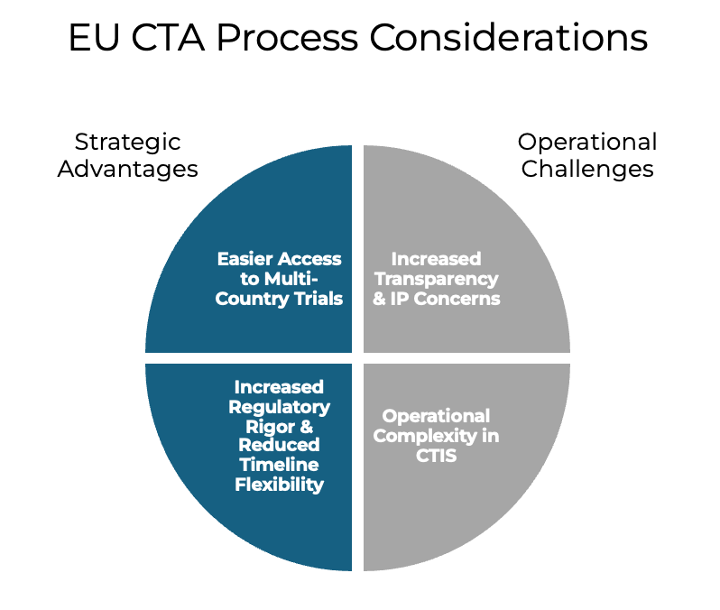
For CGT developers, the CTA process offers both strategic advantages and operational challenges:
1. Easier Access to Multi-Country Trials
CGT programs, often targeting rare diseases and requiring rapid patient recruitment, benefit from the ability to submit a single CTA and activate multiple EU countries simultaneously. This is particularly valuable given the limited patient populations typical of advanced therapies, where access might be more limited for those looking at just one country for recruitment.
2. Increased Regulatory Rigor and Reduced Timeline Flexibility
The harmonized timelines under the CTR create a more predictable framework but also remove the implicit flexibility that CGT developers previously relied on for complex products.
There is no longer a mechanism to extend assessment timelines specifically due to product complexity.
-
- This places greater pressure on sponsors to submit highly mature, complete dossiers at the outset.
- Iterative back-and-forth during review is more constrained, increasing the importance of early scientific advice and pre-submission alignment.
3. Increased Transparency and IP Concerns
The CTR’s emphasis on transparency (e.g., public availability of trial data and documents) introduces new considerations for CGT developers, especially around:
-
- Protection of proprietary manufacturing processes (e.g., viral vectors, cell engineering platforms)
- Management of commercially confidential information (CCI), which remains an evolving area of guidance and interpretation3
4. Operational Complexity in CTIS
While the CTIS platform centralizes submissions, it has introduced a steep learning curve for sponsors. CGT companies, many of which are small or mid-sized biotechs, must invest in new regulatory capabilities to manage:
-
- Structured dossier requirements
- Strict submission timelines
- Ongoing lifecycle management (e.g., amendments, safety reporting)
How CDMOs Can Help CGT Companies Navigate the Changes
CDMOs play a crucial role in helping CGT companies de-risk their regulatory submissions and accelerate trial initiation.
- Regulatory Strategy & CTA Submission Support: Preparation of CMC documentation, IMPD/IND, and clinical protocols, as well as assistance with EMA, SwissMedic, and national competent authority filings
- GMP Manufacturing for Regulatory Approval: Ensuring GMP-compliant production for clinical trial materials, including supporting batch release, stability testing, and product characterization
- Regulatory Liaison & Pre-Submission Meetings: Engaging regulators (EMA, SwissMedic, FDA) for scientific advice, providing regulatory intelligence to streamline approvals
- Clinical Trial Management & Compliance: Coordinating multi-country regulatory submissions, supporting companies in meeting ethical and safety reporting obligations
Switzerland as a Strategic Choice for CGT Trials
Alternatively to navigating the EU CTA process right away, launching FIH trials in Switzerland rather than elsewhere in Europe offers potential advantages in the current regulatory environment:
- Fast regulatory approvals starting in Switzerland to speed paths to revenue before expanding to rest of EU approvals
- SwissMedic provides more flexible scientific advice, helping CGTs align regulatory strategies in planning for their FIH trial
Accelerate the CTA Process
The new EU Clinical Trials Regulation (CTR) is reshaping the regulatory pathway for CGT companies. While the changes streamline the process, successful regulatory submissions require expert support.
Whether you are looking to manufacture for clinical trials in Switzerland or elsewhere in Europe, ENABLE Biotech provides the expertise needed to manage regulatory complexity, ensure GMP compliance, and accelerate FIH trial approvals.
Looking to accelerate your First-in-Human trials under the EU CTA process? Contact us today to discuss your strategy.
References:
1. European Commission. (2022). Clinical trials – regulation EU no 536/2014. Public Health. https://health.ec.europa.eu/medicinal-products/clinical-trials/clinical-trials-regulation-eu-no-5362014_en
2. European Union. (2022, May 12). Regulation – 536/2014. EUR-Lex. https://eur-lex.europa.eu/eli/reg/2014/536/oj/eng
3. European Medicines Agency (EMA). (2023, October 6). Revised transparency rules for the EU Clinical Trials Information System (CTIS). https://www.ema.europa.eu/en/news/revised-transparency-rules-eu-clinical-trials-information-system-ctis